CAIRNSPRESS
Issue 25: Cairns Crocodiles Conference Special Edition!

Your favourite conference-special-edition newsletter is back, sort of.
Last year we took you on a rosé-fuelled Riviera journey in Cannes. This year we’ve swapped out that pink-coloured vino for mojito-flavoured tropical chaos at the Cairns Crocodiles last week.
If you follow the SKMG LinkedIn, you will have likely seen Neil and Andrew taking to the small screen last week for day-by-day recaps of the smarter conversations on ground. If you haven’t, fear not! We’re desperate for attention, so we linked them all below for your viewing pleasure, plus a few extra chats from around the grounds.
But before we get to that, we need to vent. Crocodiles was an absolutely unbelievable event, well-produced and even more well-attended, but where is the Australian industry at when it comes to sparking smarter conversations? Well, let’s say we have a bit of an authenticity problem… it’s just not the one you think.
Our overwhelming impression from the content across the board is that the Australian marketing community is still wrapped up in buzzwords that have pervaded this industry for a decade or more.
Authenticity this, culture that, organic moments everywhere. But nobody's defining what any of it actually means – or even addressing that the definitions have likely shifted substantially – and it's stifling us from getting to the real core of what sparks a smart conversation.
The authenticity problem in question
The most glaring issue across sessions was how speakers kept invoking authenticity without clear definition. We heard multiple interpretations, but they were often creativity-crushing.
One particularly memorable example involved a presenter arguing that a poor example of authenticity they had witnessed first hand was a toilet paper brand at a music festival. Apparently the brand had no right to show up at festivals because it wasn’t authentic to its core function. “What does toilet paper have to do with music?”
Has this person ever actually been to a festival? The crowd’s immediate pushback was telling: many applauded the suggestion from another panellist that the first thing they’d appreciate in a bloody festival cubicle was toilet paper.
Obviously not all, if not most, communicators think in terms this black and white, but it highlighted a sinc-evolved definition of the idea of authenticity: that your product’s original intended function dictates which conversations you can authentically engage in.
But by that logic, if your brand promise isn’t explicitly festival hygiene, you can’t solve a glaring problem in the festival-goer’s experience. True thought leaders like Rory Sutherland have since evolved this argument by showing that some of the most beautiful and useful examples of creativity stem from brands showing up in completely unexpected places. So how is it they manage to do that and not piss people off?
What authenticity actually is
The better definition isn't about where your product has appeared before or category heritage. It’s about creating authentic value wherever you choose to show up. Samsung’s Galaxy skin in Fortnite worked because it was genuinely cool and something players wanted. People would buy Galaxy phones just to get the skin. No Samsung branding required.

The authenticity came from understanding the gaming audience and delivering real value to them. Compare that to brands forcing their way in with obvious product placement. One approach creates value, the other interrupts it. That’s the difference between being authentic and trying to look authentic.
The product foundation debate
The most interesting tension emerged around whether authenticity stems from core product delivery or marketing positioning. McDonald’s makes a compelling case for product-rooted authenticity by still delivering on its day-one promise of quality, service, cleanliness and value. The core product works, which gives permission to experiment across different cultural contexts.
Jetstar, on the other hand, will never achieve authenticity no matter how much it spends on marketing. At its core, it’s a disappointing product: cramped planes, often surly stuff, an unwieldy and slow check-in system, and unreliable, poor service. You can’t advertise your way to authenticity when your fundamental offering fails to deliver value. As someone noted in a spa-side discussion back at the hotel, “You can't eat regrets”.
But even brands with strong product foundations need to create specific value in new contexts. Levi’s (arguably one of the most authentic brands in the world) managed to move across different spaces through campaigns like Spike Lee's work, understanding how to create authentic value for different tribes while staying rooted in product quality.
The creator economy gets it
The most successful creator partnerships demonstrate this principle. When podcasters and influencers succeed with brand content, they’re creating value for their audiences first. They understand how to make brands genuinely useful rather than just mentioning them. Value creation comes first, brand association second.
This is what “let creators have creative license” actually means. It’s not about letting them run amok or be themselves - it’s about them understanding how to create value for their audience, then applying that skill to your brand. It’s the difference between brands trying to be cool versus brands actually being cool. (It is a real shame, that so many creators gibber on at conferences about wanting “creative licence” without explaining why it makes business sense. Too often they sound naive and just plain irritating.)
Moving past the buzzword hangover
This authenticity obsession feels like a hangover from pre-TikTok thinking. We’re still trying to hyper-rationalise every move when randomness succeeds and weird wins. People expect brands to pop up in strange places now, in fact, they encourage it(!) as long as they create authentic value for the community they’re conversing with.
Australian marketing needs to move past talking about authenticity as a constraint and toward value creation as the goal. Authenticity should be implicit in value creation, not a separate rule that prevents good work.
What else?
The generation opportunity
While the conference focused heavily on Gen Z strategies, Ana Andjelic's observation about Gen Alpha deserves attention. Early behavioural patterns are emerging: she pointed to their love of millennial pink as an opportunity for brands like Victoria’s Secret and others to start positioning now rather than playing catch-up later.
Australian marketing has a habit of chasing trends just as they’re shifting or come to an end. We’re doing it again with Gen Z while Alpha is already forming preferences and isn’t far from having purchasing power.
AI beyond entertainment and content creation
AI discussions remain frustratingly stuck on image generation and copywriting tools. The bigger opportunity lies in analysis and operational efficiency. We need to move past content creation toward understanding what data tells us about audience behaviour and trend patterns.
More importantly, why are we only hearing from marketers about AI transformation? Conferences such as Cairns Crocodiles would benefit from hearing from the people who are actually building these tools, not just the people trying to figure out how to use them within existing frameworks. We’re still hearing lots of chatter about experimenting and images when AI's potential extends far beyond content creation.
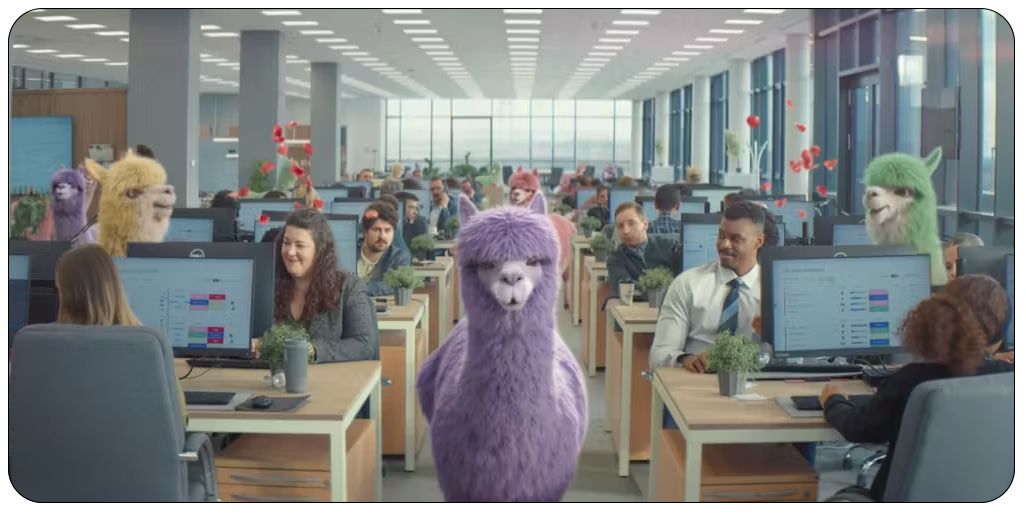
Llamas.
A good example of defying “old-school authentic convention” (new term loosely coined by SKMG right just now now) came in the only B2B session of the conference. Salesforce’s Catherine Bowe argued passionately for emotion as the driving force in business marketing. Bravery in the B2B world doesn’t mean reckless stunts; it means leaning confidently into emotional resonance and storytelling. But while Salesforce has had some interesting campaigns featuring one of SKMG’s favourite duos, Matthew McConaughey and Woody Harrelson (who have never authentically designed agentic AI software for B2B CRM management in their life, mind you), it was Monday.com’s latest campaign featuring singing llama’s that stood out. Do llamas have an authentic right to show up in an office? Hell no. Did we enjoy every second? Yes. Were we rewatching the ads at The Brewery later? You bet we were. It’s the feelings and ridiculousness of them that really seal the deal.
Now, on to the videos:

Day 2 video, with Mel Hopkins:

Cultural hits start with solving business problems creatively, and Ana Andjelic's standout session really dominated most of our conversations from days one AND two. She reinforced that modern brands are producing culture rather than riding the coattails. But her most compelling argument was about the CMO-CFO relationship and how creativity needs proper measurement and follow-through. The Jeremy Allen White Calvin Klein campaign became her perfect cautionary tale: massive cultural moment, zero commercial follow-through. Meanwhile, Facebook's “yes couch” campaign actually managed to piggy-back on the CK campaign and generate their own brand equity by finding that same couch and listing it on Marketplace.
Andjelic referenced the now famous Loewe tomato bag example to perfectly illustrate how brands can create a universe that can inform consumer behaviour and expectation: when someone posted a photo of an heirloom tomato saying “this is so Jonathan Anderson Loewe”, the brand responded two weeks later with an actual tomato bag, claiming “meme to reality”. That bag had been in production for nine months. This was years of cultural priming playing out in real time. The takeaway? Engineering coincidence is the highest level of culture dictating consumer behaviour.
Andjelic also argued that to do this, everything from physical retail spaces to film studios should be treated as storytelling disciplines rather than siloed departments. It’s no longer about monoculture, it’s about identifying the subcultures with the highest spending power for your brand and getting them so excited they use your brand as a badge of cultural subscription.
Between sessions, Forbes Australia's Editor-in-Chief Sarah O’Carroll shared with us that sparking truly smart conversations often means mixing the traditional heavyweights like Telstra, Salesforce and CBA with emerging disruptors and innovators from spaces like Web3. Seeing these interactions – where seasoned investors question founders of Web3 startups like Immutable about the fundamentals of new tech – is where ideas really flourish.
We caught up with another friend and client of ours during the conference – Sharyn Smith of Social Soup – to chat through how she thinks smarter conversations can be generated through a deep understanding of audience culture, not just superficial cultural moments. She says that brands need to grasp that audiences aren’t monolithic; genuine engagement comes from appreciating and speaking directly to the cultural nuances and intricacies that shape their lives. In her words, “to influence culture, you have to influence cultures – plural”.

On day three, relevance was precisely the keyword when Optus’ Cam Luby dissected the art of navigating corporate catastrophes. We all know the Optus ones too well by now, and Neil and Andrew took a walking tour of Cairns to break down the key points. CLIFF NOTES: in moments of brand crisis, the clarity and sincerity of your response define your future, never underestimate your audience’s intelligence (especially in a crisis), and remember reputation goes down via the elevator but always up by the stairs.
Overheard in Cairns
Between sessions:
“Let’s go snag a coffee from our competitors.”
“Benny, why are you sending me goulash?”
“That’s the good cafe over there, just below the Tabernacle of David.”
“You can’t eat regrets.”
“I’ll have just one more martini before we go to the pub.”
From sessions:
“Being culturally relevant means you need to stop interrupting and start integrating.” – Ana Andjelic
“Bravery isn't about not being scared; it's about being scared and doing it anyway.” – Antoinette Lattouf
“Gen Z sees through brands trying to be cool like they see through sponsored TikToks.” – Xanthe Wells, Pinterest
“A crisis isn't just a test of your brand strategy; it's a test of your humanity.” – Cam Luby, Optus
“In B2B, emotion isn't a nice-to-have, it's a have-to-have.” – Catherine Bowe, Salesforce
“I sat on [the NRL] board for 12 months, just getting the lay of the land because the first thing you do is make sure that you’re not a token woman. Some are happy with that, I’m not.” - Katie Page, Harvey Norman
Picks and Recs
Snack of the conference:
Pork crackle packets. A bold snack choice for those quiet moments during a session.
Best activation:
Are Media and Swarovski’s claw machine. Nothing screams “conference” quite like a high-stakes jewel grab that’s part Vegas, part fun fair.
Most surreal moment:
Watching industry veterans earnestly networking while thigh-deep in a bathtub filled with ping-pong balls at the closing party.
Honourable mention:
Our balcony’s hot tub, a nightly debrief spot, proving that smarter conversations happen best when submerged.