

The Met sent nudes
Issue 54: It means more than you think (thank God we were on Substack this morning)
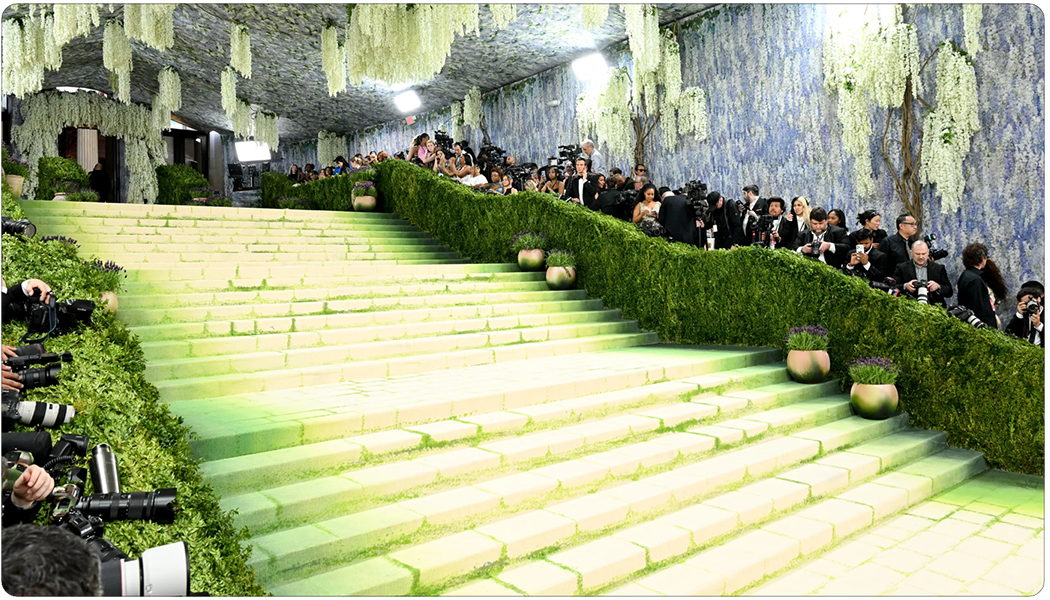
In the interests of transparency, there’s a non-zero chance this entire issue is Andrew falling for some combination of recency and confirmation bias. This morning, he saw a video on Substack from Jasmine Bina at Concept Bureau which has since rendered him physically incapable of looking at a single red-carpet photograph without seeing the same argument peeking out from underneath the gowns. The rest of us decided he might be onto something and chose, in the spirit of begrudging goodwill that holds any group chat together, to run with it. Whether what follows is a real read of where culture is sitting in May 2026 or one person doing pattern-matching with his 3pm coffee, we will leave to you. Here’s the longest, fastest-turned-around 2026 Met Gala interpretation you’re gonna get this side of a K-pop stan account that had every look screenshotted, tagged and provenance-checked before the after-parties opened… so strap yourself in, we reckon it’s worth it even if there is a stray typo or two. There won’t be.
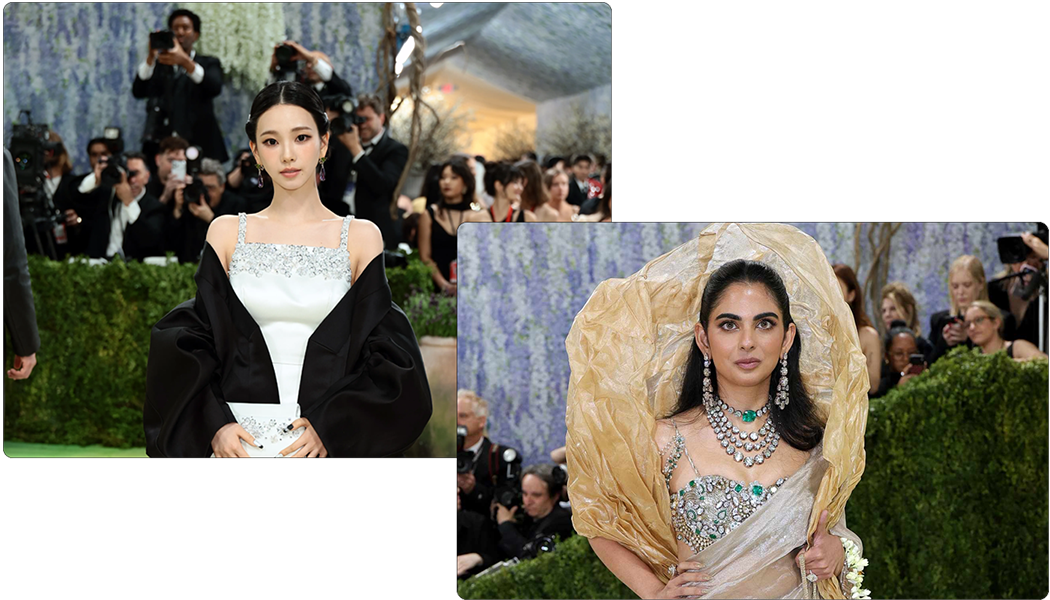
If you were an (admittedly highly culture-system-literate) alien with only the night’s red-carpet photographs to work from, we reckon the Met is a half-decent lexicon for reading where humanity’s head is at. The room is global now – Karina from aespa walked it in a Hanbok by Prada(!!), Isha Ambani in a custom Gaurav Gupta sari hand-painted with motifs from the Ajanta cave murals – this carpet isn’t isolated to one continent.
The lens we will be using for the read is Bina’s, and her argument runs briefly like this: inspiration follows culture, not the other way round. When the broader culture is stable, confident and growing, the gaze tilts upward and we idolise youth — the version of ourselves we could still become, fresh-faced and starting out. When culture wobbles, the gaze flips and we look at age, at survival, at the people who already got through something, because some part of the collective subconscious is doing quiet maths on whether we will have to as well. She was making the case in the context of the Botox pushback — the slow run of Hollywood faces visibly choosing not to freeze and the editorial pivot toward celebrating it — and by Tuesday afternoon the carpet appeared to be running the same argument in latex and pearls.
Uncanny coincidence unlikely, the Costume Institute exhibition this year is structured around body types Andrew Bolton wanted to “reclaim”: corpulent, disabled, pregnant and aging. His stated framing is body-positivity, not cultural anxiety. We don’t think he’s reading the Concept Bureau Substack but the fact that the aging body is on the wall at the Met at all in 2026 – in the same week Bina is making her reel and Bad Bunny is gluing on prosthetics – is the kind of convergence that makes you think something is actually in the air.
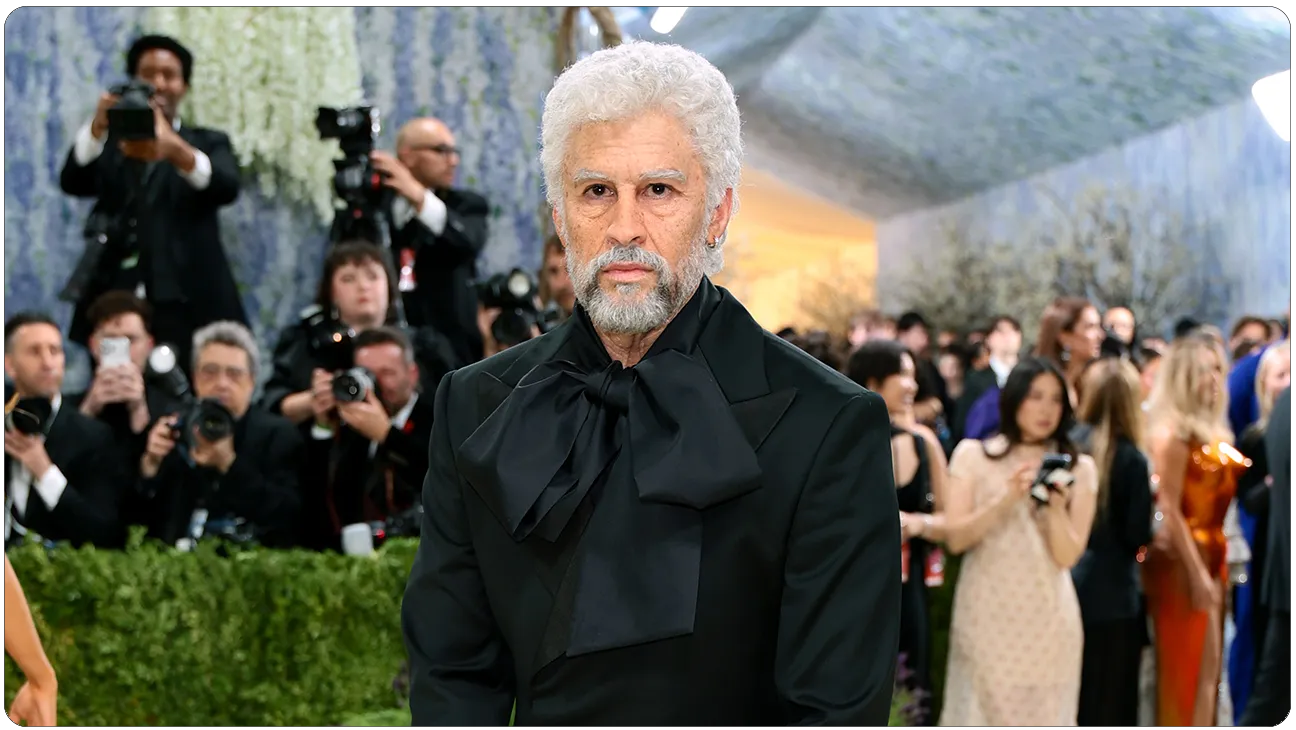
Bad Bunny is 32. He walked the Met carpet “aged” 82, with white hair, a white beard and prosthetic wrinkles by Mike Marino under a black tuxedo whose oversized bow he had — and we want you to read this part more than once — co-designed with Zara, of all the budget-tier labels in the Western hemisphere. Asked on the carpet how long the look had taken, he said “53 years exactly”, presumably because he had decided in advance not to be helpful. The most-streamed musician on the planet, on one of the most-photographed nights of the year, chose to age himself five decades and answer questions in the voice of the man he might one day become. Culture leading aspiration? Very perhaps.
Kris Jenner wasn’t necessarily responding to a brief but landed in the same place. Yes, we know, scrutinising a 70-year-old woman’s face for evidence of cultural theory is a wee bit grim, and Kris specifically has every right to do whatever she likes with her own. But we all goddamn know well enough she’s got the surgeons, receipts, and the last two-and-a-bit decades of precedent to look exceedingly taut around the cheekbones. There isn’t a particularly polite way to say what we are about to say next so we will just say it: tonight she lacked a certain vacuum-sealed quality. Whether that’s a one-night styling decision or the start of a slower easing-up, we don’t know. The data point sits squarely on Bina’s pile either way.
The biggest swing of the night was Heidi Klum, and it was a, um, whatever comes after a home run. At least it was to us, although we’ve since discovered the look was absolutely not universally praised. To us, however, it’s a hit for more or less the same reason Bieber’s MacBook karaoke at Coachella landed a few issues back: earned context has a half-life measured in years, and most A-listers haven’t banked enough of it to bet on restraint. Klum has. She walked in as a Mike Marino sculpture — the same Marino who’d been across town wrinkling Bad Bunny’s face — referencing Giuseppe Sammartino’s Veiled Christ and Raffaele Monti’s Veiled Vestal, two of the more astonishing pieces of marble work in art history, both of which depict a human figure under impossibly fine fabric.
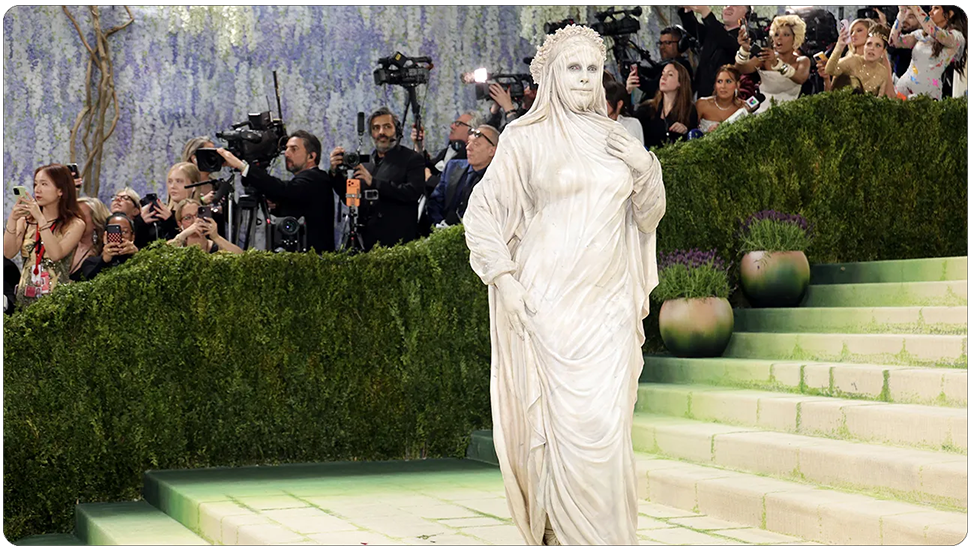
Klum’s outfit was latex and spandex doing the same trick: 11,000 hours of embroidery, 10,000 baroque pearls and 7,000 painted pearlescent fish scales on a body cast that read, from the third row, as carved stone. This violates close to every rule of being a Met Gala A-lister, but the rules don’t apply to Heidi anymore. She’s spent 20 years building a brand that’s licensed her to skip the be-hot-on-the-carpet step: Project Runway, the Halloween parties and, lest we forget, the worm costume that broke Instagram. She’s 52, technically Gen X, and her cultural coding plays out younger now than the talent half her age on the carpet because she stepped off the vanity metric a long time ago and never looked back.
The two most labour-intensive looks of the night came from the same hand. Mike Marino did Bad Bunny’s age and Klum’s stone, and the most committed couture in the room on Monday was prosthetic rather than fabric — the body itself is now the surface the craft is being made on. That probably says something about where fashion thinks the work needs to happen with AI eating the cloth side, but we will let you draw that one.
The other thing that echoed around the office this morning was an initially benign sounding observation: for an “art” theme, we expected more colour. We expected a Rothko and got a Brâncuși. The actual hue palette of Monday night was almost entirely neutral: beige and nude and bone and white and black and stone, with skin tones layered on skin tones on skin tones. Lisa from BLACKPINK arrived in custom Robert Wun: sheer ivory crystal embroidery, with a headpiece that was two replica arms moulded from her own body and posed in traditional Thai dance positions – 66,960 Swarovski crystals, 2,860 hours of handwork, not a single primary colour anywhere in the look.
That was when this stopped feeling banal and more like Bina’s argument resurfacing, albeit in a different look: the first interpretation of her theory was about aging and aspiration but the same logic extends a few floors up. The art a culture makes, and the art a culture chooses to look for, also runs in parallel to where it sits. Stable, abundant, confident cultures tend to reach for colour and experimental brightness, the visual codes that say we have the slack to play (think about the emergence of Pop Art in the UK in the mid-1950s). Less stable ones tend to reach for material and structure and weight, for the things you can prove are real because you can touch them.
Soft caveat: art movements do tend to track only loosely against the cultural confidence of the eras that produced them, and we say loosely because we are not art historians and would yield gratefully to a Robin Givhan if she fancied taking the next bit off our hands. The thesis isn’t watertight. Expressionism is the obvious counterexample, with its chromatic intensity in service of pre-WWI German anguish, and the Baroque movement belonged to a relatively stable absolutist Europe. But stability still buys colour, and instability rewards a return to form. Memphis and the 1980s go-go-go optimism some of us lived through in shoulder pads and have largely repressed. The hyper-saturated digital palette of the 2010s, when we still believed connection was the product and every top 50 track was about having the best night of your life because there was literally nothing else to be concerned about. Then brutalism, the minimalism of the early 1990s, the post-2008 austerity moment of chambray and exposed brick and bare bulbs and the faint suggestion the world might need to be rebuilt with real hands. When you can’t trust the future, you reach for what you can touch.
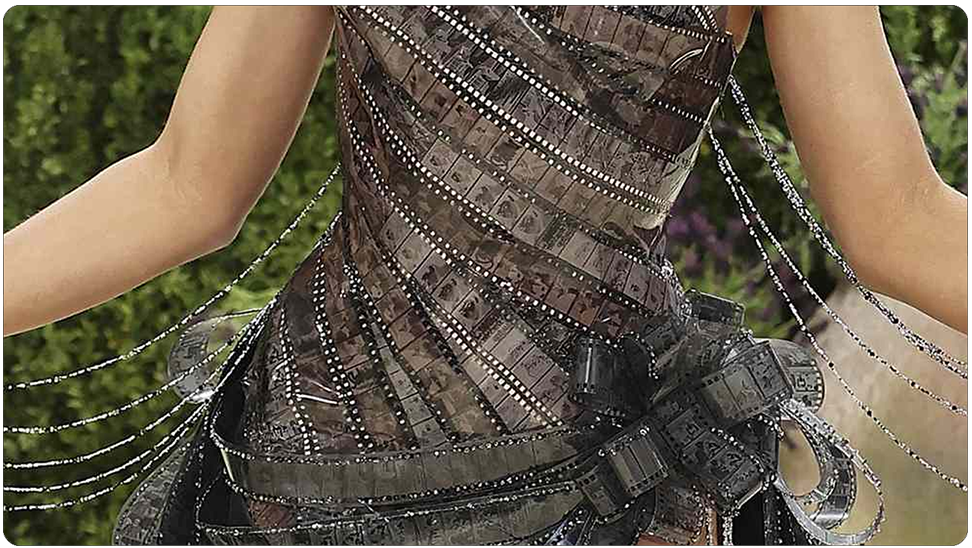
Klum’s veiled Vestal, Lisa’s Thai-dance hands, Isha Ambani’s hand-painted Ajanta murals, the whole run of nipple-forward anatomical breastplates that the Zoe Report and others have started cataloguing and the cleanest illustration of the lot, Sabrina Carpenter in custom Dior by Jonathan Anderson wearing actual 35mm celluloid film strips from the 1954 Audrey Hepburn film Sabrina, with Hepburn, Humphrey Bogart and William Holden visible in miniature across the bodice. The structural couture of the night was making one argument under cover of the costume brief, which is that cloth and material and human hands can still do things AI cannot, at a moment when most other creative industries are standing on a beach watching the AI tide roll in. That explains why the men’s looks leaned so heavily on black tie cut to 48 different structures (our pick was Patrick Schwarzenegger). Think about it: beige is what you reach for when you’d rather nothing distract from the form. Stone – or pearl, fish-scale, marble and even film celluloid – all lean on neutral pallets to reference the materials themselves.
Smaller sections of the carpet were running a different conversation with a recognisably similar accent: where there was colour, it was for sale. Jisoo arrived in custom Dior by Jonathan Anderson with draped gazar, an embroidered garden scene, vintage Cartier at the throat: gorgeous, and you didn’t have to squint hard to see Dior’s next season trickling out of the dress like a polite advance copy. This is the direction. Here are the silhouettes. You can get a version of this. Jennie, last year’s so-called “human Chanel” who walked the 2025 carpet in roughly 80% of the brand’s archival iconography, wore something this year that was barely Chanel-coded at all: a metallic column whose colour story would slot perfectly into a high-street label’s autumn drop. This is the Anderson-at-Dior, Blazy-at-Chanel pivot the industry has been talking about for the better part of 18 months: creative directors with full reins, but the reins tied directly to the till. Tom Ford has been screaming it from rooftops, Demna at Gucci is testing it, and the luxury-must-be-commercial conversation is the loudest one in the trades right now. The Met is the gallery in which it has decided to hang itself.
The Met has copped a flogging in recent years for being culturally tone-deaf and we’re not standing here defending the Met. But the thing it can’t help being, even on a year when it’s trying not to be, is a lexicon of where the culture is sitting at the moment the cameras turn on. Instead of overt politics or protest pins or slogans, we got a coordinated, accidental and admittedly beautiful collective shrug toward something more austere, older and more material. This is the art high pop culture chooses to reflect when the future feels less reliable.
That brings us, eventually, to the marketing thing. Brands have spent a decade now talking about “leading culture”. It’s one of the favourite phrases in every pitch deck we’ve ever read: we will lead the culture, define the conversation, set the agenda. Bina’s argument, and the Met’s accidental illustration of it, runs the other way. The work is reading where the room actually is, including the parts the room hasn’t yet articulated to itself, and meeting it there with some respect. The trick is building the muscle to understand the codes sitting right in front of you.
What we’re currently obsessed with
Neil

Like 126,000 other people, I follow the Cover Junkie Insta page. I don’t know how many of those 126,000 are obsessed with it. I am. I check it every day, sometimes more (yes, I actively check it). It simply gives us images of some of the most inventive and interesting magazine covers from around the world. Sure, most of the covers are beautifully designed, but more than that they spark new ideas and new ways of looking at often familiar things. I’m not exaggerating. Take a look at the post from 22 April. So smart and so surprising.
Andrew

I think I just wrote about all of it?
This is pretty compelling though, not that I’ve seen the film yet.
Tess

This week I loved the New York Times interactive piece on the Jeju Air crash in South Korea. While the story itself is obviously gripping and tragic, what I’m slightly obsessed with is how they told it.
I’m a die-hard NYT reader and I just love how good they are at interactive pieces. Frankly, I’m always surprised more outlets don’t do this. The piece doesn’t just explain what happened, it puts you inside it. You see the cockpit layout, the warning signals, the sequence of events as they unfolded.
It turns a complex, fast-moving incident into something you can actually follow and understand. It’s fantastic journalism on its own but paired with this kind of format, it becomes something else entirely.
Sam

The website of french real estate and architecture agency, ARCHIK. It’s really just a property porn website with an architecture degree… so every single listing has impeccable art direction and perfect mise en place. None of it is within reach, but that’s kinda the point here. Sometimes you need to take your mind off things and look at some herringbone floors and french natural light.
Eliza

Tackling my TBR list once again, I picked up James by Percival Everett. Everett flips the perspective of the events in Adventures of Huckleberry Finn and tells a first-person narrative in the voice of Jim (or rather James), the novel’s enslaved runaway. The pair’s adventures on the raft down the Mississippi River, was largely from Huck’s perspective, a lark. From Jim’s point of view nearly every second is deadly serious. This has got me thinking back to my creative writing bachelor discussing subversive texts and adaptations. Though i’m yet to decide if it beats the GOAT of adaptions, Clueless and Emma by Jane Austen.