

Pity the voter
Issue 55: On beer, gas, birthday cakes and the death of the second sentence
We took a week off writing after the deluge of Cairns Crocs content but COMMPRESS is back baby! COMMPRESS forever! One hundred years of COMMPRESS! …one of us watched Rick and Morty last night. ANYWAY. Speaking of the endless cycle of hot takes and useful massaging advice masked in frivolous cultural commentary we seem to have found ourselves on, let’s hark back to the first issue we ever wrote: Pity the Reader. It was October 2023 and the case was fairly basic: audiences are restless, distracted and prone to muddling things up, so the job of anyone trying to communicate to them is to make their life easier rather than harder. Kurt Vonnegut had said it 40 years earlier and we cribbed his line.
Fifty-four issues later, the past fortnight in Canberra lit that principle up in capital letters: a senator parlayed a single sentence into national headlines while the Federal Government futzed about in an explanatory war over its own Budget, one it lost to AI memes of Albo.
That’s right, it’s COMMPRESS goes Canberra!
Don’t get used to it.
David Pocock may well have read Vonnegut’s How To Write With Style: he refuses to write a second paragraph. He says the one sentence he wants the country to repeat, then he stops. Most of us were trained to assumes the audience will hear you out through the build, context, and back-half all the way to the bit where the framing finally makes sense. Pocock runs different.
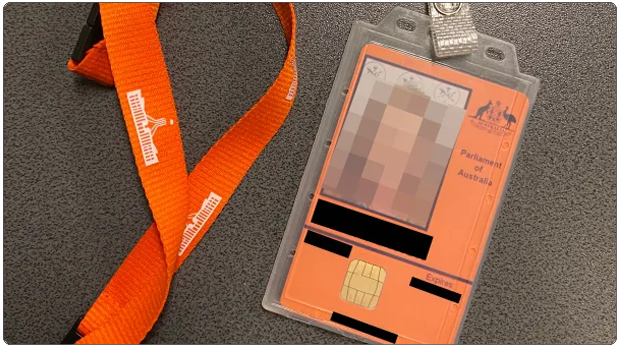
Take the orange passes first. There are about 2,200 “orange pass” holders in Parliament House: people granted unescorted access to the executive wing, free to wander the corridors where the actual deals get made, attached as guests of MPs and Senators. The federal lobbyist register doesn’t catch most of them. It captures 287 names and the remaining 2,000-odd people pass through the building’s private suites with the sort of anonymity credit card data robbed the general public of years ago. A Transparency International audit scored the process a whopping 17 out of 100 for transparency, putting Australian federal lobbying rules just behind Slovenia and a comfortable distance below Chile. Spicy.
Pocock’s response was almost embarrassing in its modesty…
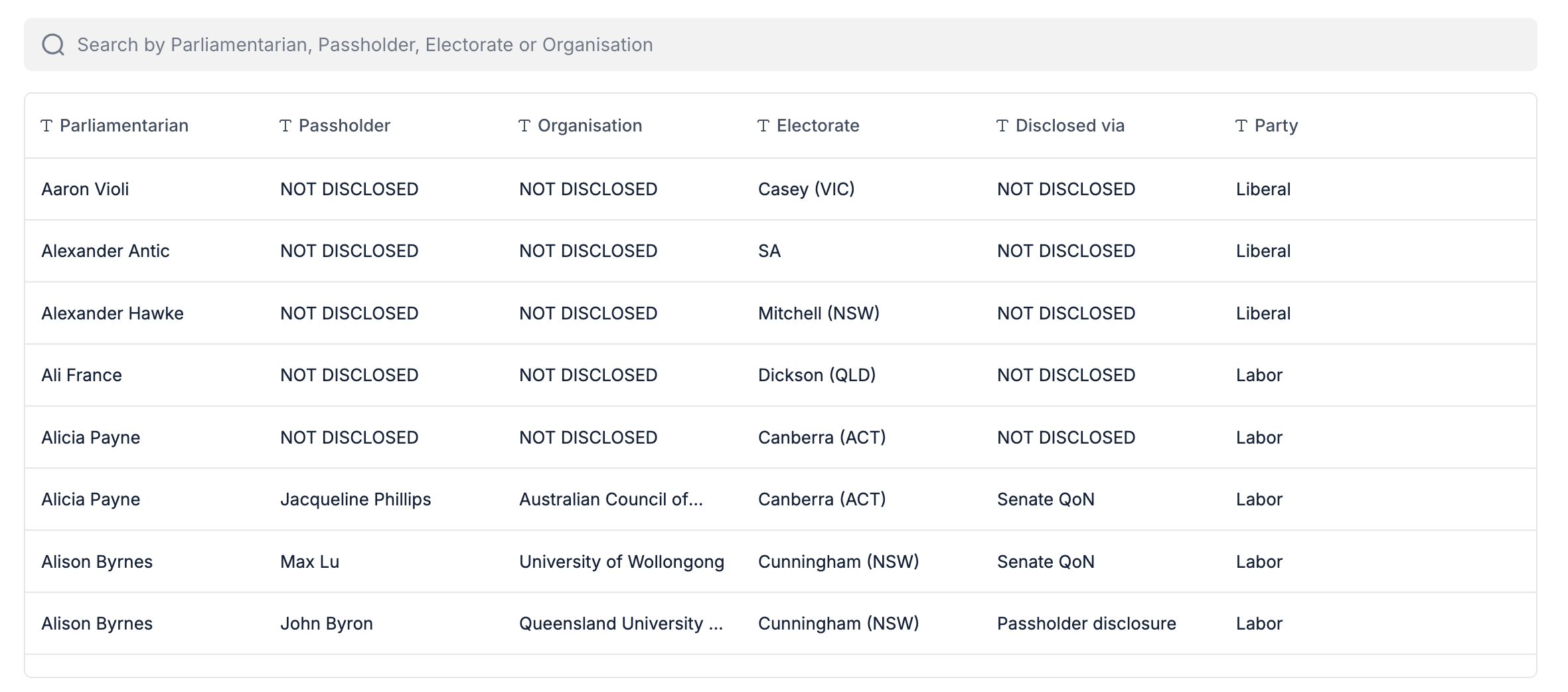
passregister.com.au, launched September 2025, asks parliamentarians to voluntarily disclose who they’ve sponsored. By April this year, six pass-holders had identified themselves, 14 MPs had volunteered some of their guests, and the disclosed total had crawled up to 201 of 2,204. Not a single member of Labor, the Liberals, the Nationals or the Greens were keen to play ball.
The site wasn’t so much the final point as it was collateral to land a simple message: more than 2,000 people walk the halls of Parliament House without any transparency around who they are and who gave them access. You don’t need to know what an orange pass is, or how the federal lobbying code interacts with anything, or what “in-house representative” means as a category exemption. You hear the sentence once and respond with something akin to “oh shit”. Pocock could have built an inquiry and taken his sweet time with it; instead he opted for a one-liner. By the time Anthony Albanese formally declared that unescorted parliamentary access was “a privilege rather than a right” and wrote to the presiding officers requesting a review, the argument had already been won elsewhere.
Then there’s gas. In Senate estimates in February, Pocock asked a Treasury official to confirm a number: revenue from offshore gas via the Petroleum Resource Rent Tax was expected to come in at $1.5 billion. Revenue from beer excise: $2.7 billion. So Australia taxes beer drinkers nearly twice as hard as we tax the country’s gas exports. Genius. Pocock followed with one sentence: “How do we live in a country, one of the biggest gas exporters in the world, and we’re getting more tax from beer than PRRT?” Fifty-seven seconds of footage, cut by Konrad Benjamin at Punters Politics, pushed onto Instagram is currently sitting on close to 10 million views. Japan, reports estimate, collects around $1.8 billion taxing imports of our gas: more from buying it than we do from selling it. By the time Albanese was being asked about a gas tax hike before Budget night, the answer had been forced into political territory the government would not have chosen to occupy. They ruled it out but they had to talk about it anyway.
Notice what the sentence is doing. We’re getting more tax from beer than PRRT. The comparison is technically rubbish, in the sense that the two taxes don’t measure the same thing or operate the same way. The gas industry will tell you it contributed $21.9 billion in 2024-25 once company tax and state royalties are stacked in, and they have a point but that point requires a paragraph. Pocock’s requires a beer. The shape of the argument was the argument, and you didn’t need a degree to feel where the wrongness was.
The Federal Budget two weeks ago is what happens when you forget that. Jim Chalmers handed down substantial changes to negative gearing and capital gains tax: the 50% CGT discount, in place since the Howard era, replaced by an inflation-indexed model paired with a 30% minimum tax rate on net capital gains. The framing the government wanted was housing: make it less attractive for people to hoard properties, free up supply for first home buyers, do something defensible about a market the Bloombergs of the world have started writing about in tones normally reserved for natural disasters.
Treasury, according to the AFR, advised broadening the change to all asset classes, including business sales, equity, crypto, the lot. The government took the advice. They probably had to. Then they had a really, really shitty fortnight.
Within 48 hours, AI-generated images of Albanese were circulating with “business partner” memes pinned underneath them, claiming a new 47% tax rate on the sale of any successful company. The actual government modelling had the average tax rate on capital gains rising from 19.3% to 21.4%: a modest increase by any reasonable measure, and one that left four pre-existing small business concessions intact. The general public kind of missed that one. The “47%” took the headline, even when it was wrong in most cases, because it’s short, sharp and it’s frankly a bigger number is a better hook for clicks (go read Cialdini FFS).

Forty small business owners under 40 wrote an open letter to the Prime Minister. Twenty-four hours later, 10 female founders wrote a second one, more pointed than the first: We are not political operatives. We are women who had an idea, took a risk, and worked incredibly hard to build businesses – often while raising families at the same time. The Australian put four small business owners from Chalmers’ electorate on its front page in little boxes. NSW Premier Chris Minns broke with the Federal Government over bracket creep in the same week.
The Treasurer’s response was to argue that the critics were running a “scare campaign built on lies” and to dismiss the founders as “political opponents” doing what political opponents do. Paul Keating arrived to help, telling everyone that only “wealthy people” were complaining, and that “punters with a big idea won’t be put off by some marginal change to the tax rate”.
The government built a complicated message and hoped the explanation would land before the tabloid interpretation did. This was ill-informed. Why? The first sentence available to a casual receiver – Labor is taxing every successful Australian small business at 47% – got to the kitchen table days before the qualifiers, the carve-outs, the four pre-existing concessions, and the assurance that the average effective rate will move by just two percentage points. The wrong sentence had already done its work, and Chalmers was reduced to telling a media pack that the misinformation was misinformation. That’s a pretty tired line for a government in trouble, and even then nobody has ever found it convincing.
Two weeks ago journalist Ed Coper – whose new book on exactly this subject is called Angertainment – went on Betoota Talks and ran a deliberate experiment to prove the impatience that exists with general audiences, and then some. He spent a sliver of the episode accusing the hosts, Clancy Overell and Errol Parker, of being part of what’s wrong with journalism: fake journalists with no background, undermining real reporting, taking the piss at the expense of work that matters. He played it dead straight, at length, with a deliberately arcane okay-boomer rigour calibrated to enrage Betoota’s audience. Clancy let him cook before thanking him for the masterclass in rage bait, pulling the rug to reveal that this sequence was, indeed, a bit. Clipped into a neat little reel for the social medias, Coper encouraged the Betoota boys to run a test, which he then went to his own socials to explain: exceptionally few viewers – of which there were many – stuck around to discover Coper didn’t mean what he was saying. The comments section had exploded in vitriol with blue-tick accounts and civvies alike spitting hate and typos at whoever the fuck this Coper bloke thinks he is.
That was the point. Vitriol takes the headline before you have a chance to close the loop. The people you’d expect to know better – the credentialed sceptics, the well-followed accounts, working comms operators – get caught at exactly the same rate as everyone else, because the platforms reward the front half of an argument and punish the half that does the explaining. There is no winning slow.
That’s the lesson Pocock has internalised, more or less by instinct. It’s the same one Labor, tragically, has not. Pocock’s sentences are smaller: small survives the trip from a Reel to a coffee shop to a parent reading aloud at the dinner table. Whatever the Federal Budget actually does in the housing market over the next decade is now beside the point, because the version of it that lives in the public imagination is a 47% tax on Australian ambition. Good luck pulling it back.
Albo and Chalmers are not the first politicians to fuck up the selling of a tax change. On 3 March 1993, John Hewson sat down with Mike Willesee on A Current Affair, 10 days out from a Federal election that Liberal HQ had already started writing the acceptance speech for. “The Fightback!” package was real tax reform: GST balanced by income tax cuts, the abolition of sales tax and compensation for pensioners.
Willesee asked Hewson a simple question: “If I buy a birthday cake from a cake shop and GST is in place, do I pay more or less for that birthday cake?”
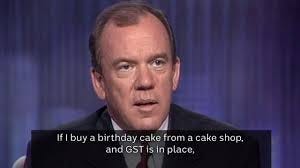
Hewson, who we all thought knew the policy inside and out, started talking about whether the cake was decorated, whether it had candles, whether it attracted sales tax in the first place, what the scrapping of sales tax would do, how that interacted with the partial backdown on GST for food, and what “food” technically meant under the revised policy. He was, technically, answering the question. Willesee waited. Then said: “If the answer to a birthday cake is so complex, you do have a problem with the overall GST?” When it comes to comms nightmares, they don’t get much worse than that. (Sidebar: Hewson used to write a regular column for a business magazine Neil edited. He was a good writer, certainly much better than he was as a TV interviewee.)
Ten days later, Hewson lost the unloseable election. Years later, on Andrew Denton’s couch, Hewson said he should have told Willesee to get stuffed. That’s also instructive: by 2006 he had the right answer. He just didn’t have it in 1993, on TV, in front of the audience that mattered.
Hewson had a paragraph. Pocock had a beer. What Hewson and Chalmers share, three decades apart, is that their messages were correct in a context that no longer exists: the context of a receiver who hears you out.
The honest version of the lesson sits between two cheap alternatives. Lying is one cheap option and oversimplifying past the substance is another. The road between involves finding the version of your message that travels the new distance without rotting: transparent enough to expose its own logic to a casual reader, accurate enough that the people who do read on to the second sentence don’t catch you in a sleight of hand. Pocock did that with the lobbyist register and with the gas clip. The Labor budget team did not, and now they are going to spend the second half of the year explaining a policy through a fog of memes they helped create by underestimating how short the room had become.
There’s a temptation in our line of work to read all this as a depressing argument for dumbing things down. Nah. Pocock’s sentences are transparent: they expose the underlying logic of the thing they’re arguing about in a way a “normal” person gets. That’s a higher standard than complexity, and the people who can hit it are the ones who will be heard.
Pity the voter who reads. Pity the reader who votes. Pity the comms team that still thinks the second sentence is going to be heard. Build a first sentence that can do the work of both.
The irony does not escape us that this issue was 2,248 words.
What we’re currently obsessed with
Neil
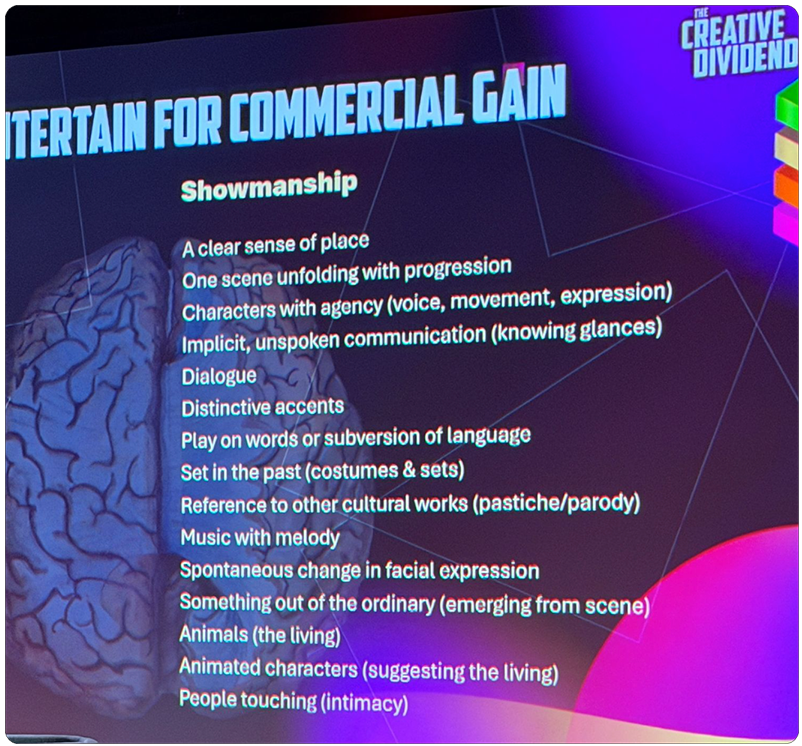
Look, I’m cheating here. I saw this slide two days ago during a conference presentation by English advertising effectiveness expert Andrew Tindall, so it’s not a full week’s obsession. It’s a list of the “showmanship” ads should include to be effective. It’s based on a mountain of analysis of ads that won awards because they were effective (versus ads that win awards because they look good and/or were created with one audience in mind: the award judges). Take a look and tell me that Tindall’s list doesn’t make sense?
Andrew
For some time now I’ve been illogically, unreasonably obsessed with the Royal Mecca Clock Tower. This week, posthumous coverage of the Hajj is really flaring that emotion like a red rag to a bull. It’s a perfectly breathtaking monolith to fossil-fuelled capitalism that looms over one of the most sacred locations on the planet, which, I dunno, screams Dune or Bladerunner to me or something you figure it out. This 12-year-old piece Bashad Peer article in The New Yorker does a better job of explaining it than I clearly can.
Tess
Mine is very random and there’s absolutely no deep marketing or comms lesson in it, as far as I can tell. I’m usually a fan of a tenuous link but even I can’t find one here. But lately I’m obsessed with watching dash cam footage. I keep getting compilations from Epping Road in my feed? The footage is suspenseful and the drivers are idiotic. Simply fantastic stuff.
Sam
It’s very specifically this paragraph from Rachel Karten’s Link In Bio Substack piece “Mystery is the best marketing”:
“People want to be at the start of something. That’s our urge to be a part of the meta-narrative. I often get asked what it means to break through in culture. We used to look to views. Now, I’d argue it’s participation. When I study the most-watched videos on TikTok every month, I’m always surprised at how few actually broke through culturally. I know something is resonating today when the more interesting content is being made in comments sections and on personal accounts. Content about the content. The ‘red flats queen’ video from the Met Gala isn’t what made the moment break through. It was the speculation. Who is she? Where does she work? What’s going on?”
Eliza
NASA unveiled plans for a permanent moon base to establish, in their words, “sustained human presence... [with humans] living and working on the moon”. But why?