

Cooking the books
Issue 59: On receipts, kitchens and the only argument we’ve had all year
Neil asked Sam the other day whether we’re supposed to be keeping receipts. There was a pause – the long kind – where five people who run a communications consultancy work out that yes, obviously. And no. We haven’t been. End of financial year does that to you. Everyone is reconciling and lodging and proving the year happened the way they said it did. Clearly we hate that prospect so instead we’re looking back to fondly reconcile our COMMPRESS issues rather than accounts. As it happens, we’ve noticed we’ve been having the same discussion all year.
Turns out we have a type.
Run the tape: the David protein bar and its pound-of-flesh lawsuit, Bieber’s MacBook karaoke at Coachella, the Banksy unmasking, Pattie Gonia and her carabiners, Pocock and his beer, the Knicks and their cookie all present as six unrelated things we found interesting. But lined up they share a common thread, a question, if you will: does the product have to be good first or can the story carry it?
You already know the answer. At least we hope you do, if not we’re doing a horrible job of communicating the point in these issues.
The story carries what’s real and buckles under what isn’t.
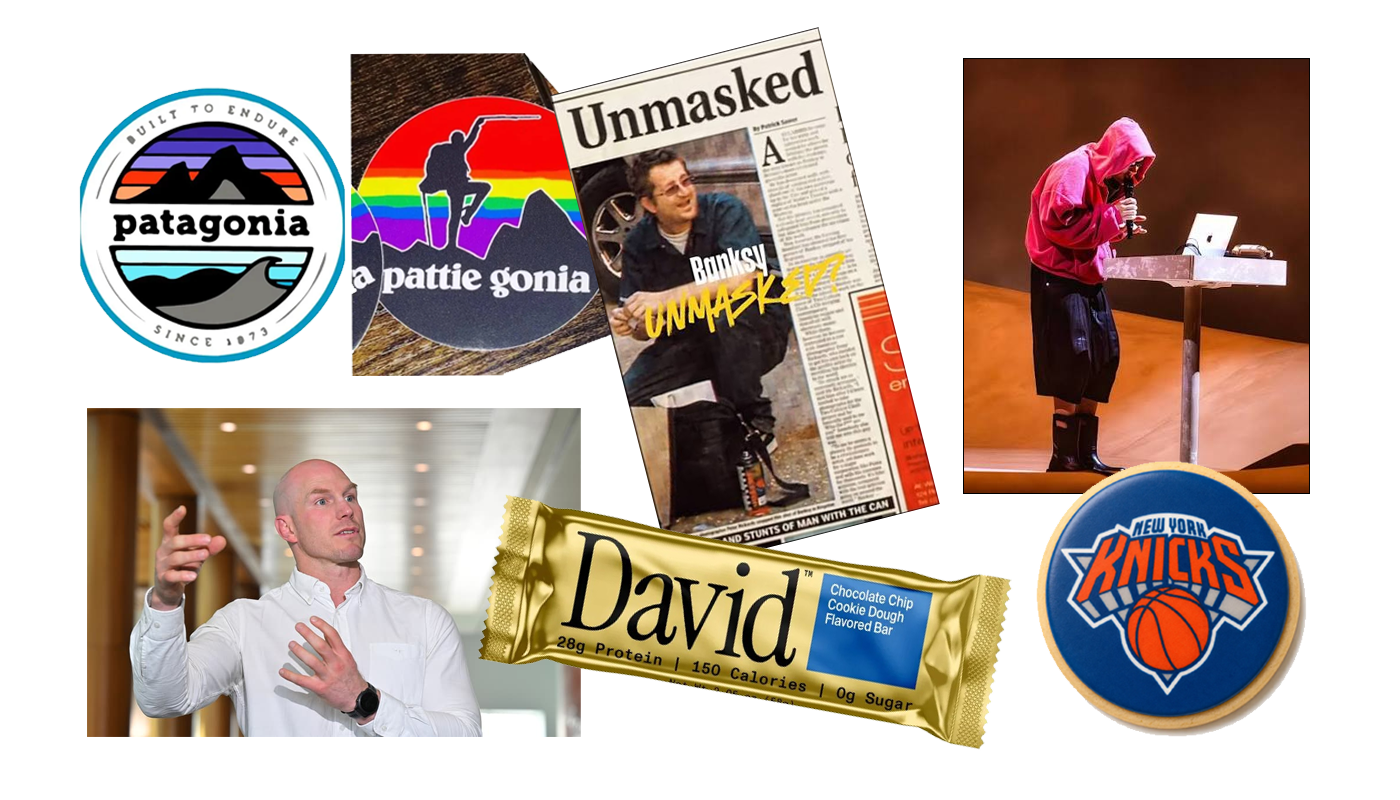
Our celebrations of smart conversations over the past 12 months have really been an acknowledgement of the intelligent ways brands have endeavoured to amplify the good, not hide the bad (incidentally, an SKMG company value). David survived a lawsuit because the bar truly delivers – 28 grams of protein, 150 calories, zero sugar – before a dollar got spent on marketing. Bieber’s laptop set soared due to years of banked goodwill. Pocock can tell it how it is because there isn’t a millimetre of daylight between the man and the message.
This is the tenet we bore clients with daily. But end of financial year is for going back on time, so here we are: Act, Explain, Amplify.
Long-time readers know it as the format this newsletter ran on for years before we got cute and dropped it. What it actually is, and was first, is how we run the work: the spine of our retainers, the order we walk a client through a strategy, the thing we’d defend in a room full of people paying us to be right.
As it happens, a communications professional we greatly admire (and only discovered about a fortnight ago) has landed on the same concept tied to a much more palatable metaphor. Lulu Cheng Meservey ran comms at Substack and Activision and now tells anyone who will sit still that traditional PR is dead and founders/CEOs should speak for themselves. She tells clients to think like a kitchen. You cook a dish, then you plate it. The dish is what you actually do; the plating is how you serve it up. And – her line, not ours, though we’re furious we didn’t get there first – you can’t plate up shit.
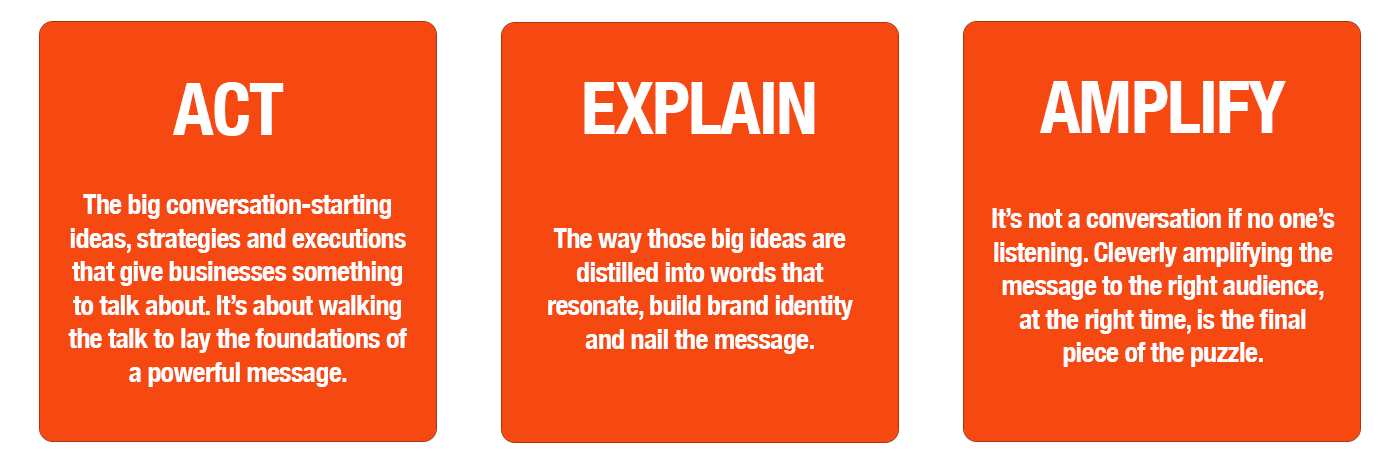
Act speaks to the ingredients of the dish. It’s the produce but it’s also the concept and intent behind the thing you’re ultimately eating. Explain is the cooking: taking what you’ve got and putting the thing together for your audience. Amplify is the plating and serving. Good plating won’t rescue a bad dish, but a great dish survives clumsy plating and still gets eaten. Read: if the product ain’t good, no one’s lining up for a second serve. Lulu, if you’re reading, the cheque’s in the mail (please send a receipt apparently we’re supposed to keep them).
So, when it comes to Act, it’s not all that hard: good produce? Great meal. Simple. This is the reason heaps of Australians will bore you with the observation they’ve had better [insert foreign cuisine here] at home than in said meal’s country of origin. But before the cooking begins you need a good concept as much as a decent Harris Farm. That is, you need to clearly understand what it is you’re doing to walk the talk accordingly.
Meservey has a ladder for this part too: three tiers of story a company can tell, if your product, your action or your dish can deliver a satisfying answer for tier three, you’re onto a winner. Tier one is what you literally do: SpaceX builds rockets. Tier two is what that represents: SpaceX is dragging space flight back out of government hands. Tier three is the dent you leave if you win: SpaceX makes us multiplanetary. Don’t get caught mouthing tier three while you’re still fumbling tier one. Anyone can tell you about the dent they’re putting in the universe; far fewer can show you the rocket. The best communicators are in the kitchen early, making sure there’s a real dish – that the business does something worth the story – rather than getting handed a plate at the pass and told to make it sing. The David bar’s first job was to be a good bar. That call gets made in the test kitchen, long before any release, and no release could have made it.
Then you get to the cooking (what we call Explain). This is where most good things die of vagueness. The sharpest knife we picked up this year belongs to Harry Dry, who runs three questions over every line he writes: can you see it, can you falsify it, can nobody else say it? Three no’s and you’ve written rubbish. Three yeses and you’re cooking with gas.
In a recent episode of How I Write, Dry gives the example of a recruitment ad he clocked on the way to a meeting: “Don’t just get a job, change an entire industry”. Shut your eyes. Can you picture “change an entire industry”? Nope. True or false? Neither. Could a rival run the identical line tomorrow? Obviously. Now New Balance: “Worn by supermodels in London and dads in Ohio”. You can see both of them, the model and the dad at the barbecue. It’s true: supermodels do, dads do. And nobody else can say it, because the supermodels aren’t in Reebok and the dads aren’t in Prada. Start with the soul, end with the sell, as Dr Marcus Collins keeps telling us and we keep quoting, because he’s right. That’s cooking: a truer telling of what the dish already is.
Only then do you plate. Amplify is distribution. We won’t pretend channel doesn’t matter, the right plate is exactly why a niche running magazine could recontextualise Harry Styles when another late-night couch never would. But it’s the last move, it requires something Neil spent the entire meeting trying to land: consistency. You don’t plate once. You keep going past the novelty, past the point it stops being fun, past – his phrase, cleaned up for a family newsletter – the urge to be sick. Leave the cake in the oven longer than feels comfortable (thank you Mark Ritson for that one). The spark at the top counts for nothing if you bail at the first quiet week.
That brings us, eventually, to the noise of late. You may have noticed your LinkedIn feed spent the past few months discovering that comms is more than PR… A revelation that – perhaps most concerningly – seems to be mostly made by publicists beating their chests that publicity was never the whole job (while still listing publicist in their LinkedIn headline). There are posts, diagrams and the odd practitioner explaining at length and to applause that what they do is “Strategic” and not merely the issuing of media releases. No shit. We’ve been at this since issue one.
The job – Lulu again – is getting the story and the evidence right, which is Act and Explain doing their work long before anyone drafts a release. That stopped being a revelation around here a long time ago. We’re not sure it needs a parade.
It’s reached the mainstream now, mind. Katie Deighton wrote it up for The Wall Street Journal as “The Revenge of the Publicists: How Comms Execs Stormed the C-Suite” and measured the win the way the genre likes to, in org charts: nearly half of chief communications officers now report straight to the CEO, up from 37% a decade ago. Sure. But reporting lines and C-suite titles are a strange thing to wave around as proof you matter, and counting them out loud has the whiff of the kid who’s been bumped to the front seat and needs the whole street to see. The brands we work for couldn’t tell you who we report to. They can tell you whether anyone believes or listens to what they have to say.

So measure it where it actually shows up: in the dish, the story, whether the audience walks away believing what you are saying. Hand the comms people the plating and nothing else and you only ever get it at the pass, dish already set. Bring them into the kitchen – the strategy, the product call, the cooking, the plating, the slog of doing it again next week – and your comms partner earns their keep at every station instead of the last one.
That’s the year, reconciled, the same sentence on a loop since July: make something real, then we’ll talk about how to serve it.
Embarrassingly unglamorous, as these go. We don’t have a growth hack, nothing you could spin into a nine-slide carousel, just the oldest rule in any kitchen restated by us and a year of case studies. But, maybe that’s a refreshing change to the unsubstantiated hustle bros hocking their AI courses in your instagram feed right now (just us?).
Pity the reader who only ever gets the plating.
What we’re currently obsessed with
Neil
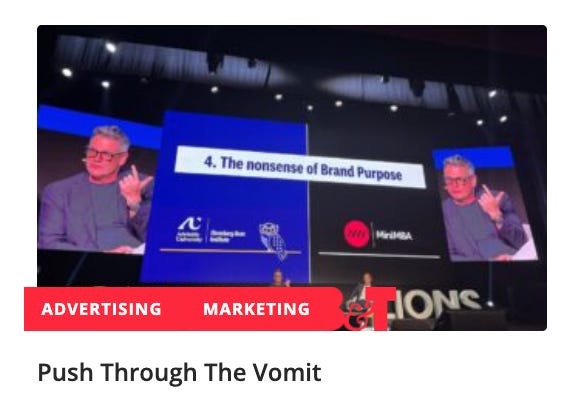
The phase mentioned above that Andrew cleaned up for a family newsletter was this: “push through the vomit”. Hardly shocking. It was the headline of this article in B&T, in which ad man Ben Lilley wrote about the Cannes ad festival presentation by celebrity marketing nerds Mark Ritson and Byron Sharp. Towards the end, the article talks about what Ritson said on the critical importance of consistency in all comms - paid, owned and earned. THAT is my obsession. If I had a dollar for every time I said marketers get sick of comms campaigns long before consumers do, I’d easily have enough for a first-class flight from Sydney to Nice, then a limo to Cannes (not the crazed Uber driver Sam and I had one year). As Ritson so colourfully put it, you need to push through the vomit and avoid change for the sake of change. Be consistent. Always. Don’t get bored or start scratching around for the next new thing. Deliver your message over and over again. That’s how I convinced journalists the Big Bash League in 2013 had one million viewers on Ten. It didn’t always… but that is an obsession for another issue.
Andrew

Here’s a sentence you may only read once in your life: This week I’ve had Alan Greenspan on the brain. Specifically thanks to John Cassidy reviving his New Yorker profile this week after Greenspan’s passing.
Cassidy’s picture of an all-singing, all-dancing chairman of the Fed is whimsical. Not something you typically expect regarding an ironclad pragmatist who spent 18 years at the most powerful economic lever on earth. And yet for all his brilliance, Greenspan’s unwavering faith in the invisible hand still led to that market crash in 2008. Even if he had left the role two years prior, Greenspan himself confessed to learning a lot from that. The piece leaves you with an ominous feeling the rest of us didn’t, at least if the market politics of today are anything to go by.
Tess

My obsession this week is the New York Times article on the UK’s “Hot Podium Guy”, Tobias Gough, the Downing Street staff member whose job is to wheel out the lectern and microphone before major announcements by the Prime Minister. Anyone who’s followed British politics over the past decade knows Westminster has been an absolute circus, but through prime ministers, resignations, scandals and snap announcements, Tobias has been the one constant, calmly setting up the podium.
The fact he’s become a genuine cultural icon is just so funny to me. Katie Glass from The Times described him as “the one reliable man in politics” and a mix between “a choirboy and a Chippendale”. Others have nicknamed him the “harbinger of doom”, because the moment he appears, everyone assumes someone’s about to resign.
It’s such a brilliantly British story. After years of political chaos, the only truly trusted figure in Westminster is the bloke who plugs in the microphone.
Sam

Mexican Batman.
Let me say that again: Mexican Batman.
Over in Jalisco, Mexico, there’s an unidentified person hunting down motorcycle thieves at night, duct-taping them to lampposts and leaving the stolen bikes beside them with signs detailing their crimes. Five men in 10 days (so far). It’s some vigilante shit and wholly deserving of the moniker. Police, for the record, are treating the taped-up men as victims and are now actively looking for the vigilante… which I guess is legally correct but it’s narratively devastating. Reminder that this is the same state that’s hosting FIFA World Cup matches and dealing with cartel violence, so I do love the idea that a guy with a roll of duct tape is making news and winning the public over. Even if it’s not a good legal framework, he is doing something. And surely you’ve read enough COMMPRESS issues to know that the person who acts immediately, visibly and even imperfectly often wins the narrative.
Eliza

Can I talk about Charli XCX yet? This weekend, she released Wink Wink, the third single from her upcoming new album Music, Fashion, Film, already drawing criticism and flop predictions after the cultural phenomenon of BRAT. In Rolling Stone, Charli framed the pivot not as a defence but as the point. “All of my albums work in opposites,” she said. “They repel against each other, and that's the connective tissue.” She could have made BRAT 2, the safe, commercial move she has called “painfully borinG”. Instead, her consistency is refusal: not a repeatable sound, but a commitment to never making the same record twice or chasing a high that was beyond her and her management’s control. That only works because her fans have already bought into her as a continuous, evolving artist rather than a fixed product – I fear the whole point of The Moment.